The ProcureSQL team is bringing practical insights on SQL Server performance, data protection, Power BI, and Microsoft Fabric to two Day of Data events this October.
John Sterrett will present in Pittsburgh on Saturday, October 10, 2026, followed by Meagan Longoria in St. Louis on Saturday, October 24, 2026. Both events offer in-person opportunities to learn, connect with fellow data professionals, and explore solutions to real-world data challenges.
- John Sterrett, CEO of ProcureSQL, will speak at Day of Data Pittsburgh on Saturday, October 10, 2026.
- Meagan Longoria, Data Analytics Architect at ProcureSQL and Microsoft Data Platform MVP, will speak at Day of Data St. Louis on Saturday, October 24, 2026.
Day of Data continues the long-running SQL Saturday and PASS community tradition, bringing together data professionals for a day of practical learning, technical sessions, networking, and conversations about the tools and practices shaping modern data work. Whether your focus is SQL Server, analytics, Microsoft Fabric, Power BI, data engineering, AI, or data leadership, these events create a valuable opportunity to learn from peers and practitioners who work with real-world data challenges every day.
John Sterrett at Day of Data Pittsburgh
Where: Commonwealth Charter Academy, The Waterfront, 162 East Bridge Street, Homestead, PA 15120.
At Day of Data Pittsburgh, John Sterrett will present:
DBA Basics: Getting Started with Performance Tuning
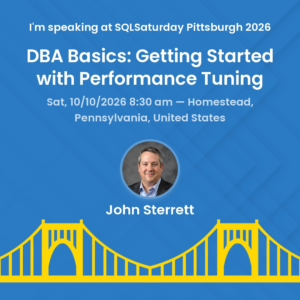
This session at Day of Data in Pittsburgh is a good fit for newer DBAs, developers, accidental database administrators, and IT professionals who want to build confidence in performance tuning.
Performance problems can be intimidating—especially for newer DBAs, developers, and accidental database administrators who inherit an environment where users are already reporting that “SQL Server is slow.” John’s session provides a practical starting point for identifying and addressing common performance issues.
Attendees will learn how to find the most resource-consuming statements and get foundational guidance on reading and understanding execution plans. The goal isn’t to chase one-off fixes; it is to build a repeatable process for investigating performance problems, prioritizing the most meaningful opportunities, and making informed tuning decisions.
This session is a great fit for:
- New and aspiring DBAs who need a usable performance-tuning framework.
- Developers who want to understand how query design and execution plans affect application performance.
- IT professionals responsible for SQL Server environments who want a clearer troubleshooting process.
- Data professionals who want to move from reactive firefighting toward more proactive database performance management.
Advanced Data Protection Strategies with SQL Server
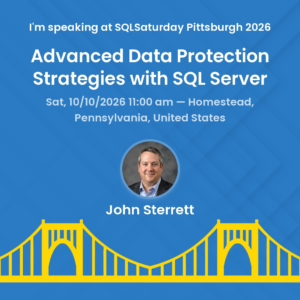
For teams responsible for database security, application access, or data governance, this session at Days of Data in Pittsburgh is for you.
As organizations manage growing volumes of sensitive data, protecting that information requires more than defending against external attackers. Application users and privileged employees—including database administrators—also need appropriate boundaries around what they can access.
In this session, John will explain how to protect data while maintaining functionality and performance. He will explore three key capabilities:
- Column-level encryption.
- Row-level security.
- Auditing.
Attendees will leave understanding how and why these capabilities contribute to SQL Server data protection, helping them make more informed decisions about securing sensitive information.
For teams responsible for database security, application access, or data governance, this session complements the performance-tuning fundamentals with another essential responsibility: protecting the data entrusted to your organization.
Day of Data Pittsburgh takes place on October 10, 2026. If you are attending, be sure to connect with John, ask questions, and share the performance challenges you are seeing in your own SQL Server environment.
Meagan Longoria at Day of Data St. Louis
Two weeks later, Meagan Longoria will represent ProcureSQL at Day of Data St. Louis on October 24, 2026, hosted at the Microsoft Technology Center in St. Louis.
Where: Microsoft Innovation Hub, Microsoft Technology Center, 4220 Duncan Avenue, 5th Floor, St. Louis, MO 63110.
Meagan will present:
Challenges and opportunities in using AI for Power BI Report Development
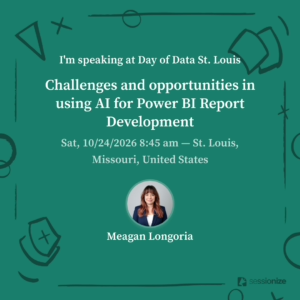
Exploring AI for Power BI development, this session will help you think beyond speed and focus on the quality and usefulness of the finished report.
AI-assisted report development is generating plenty of excitement, but it does not remove humans from the design process. Why do some attempts to generate charts and reports with AI work well while others fall flat?
Meagan will examine the report and visualization development process, taking an honest look at what AI tools can do today and where human judgment still drives the outcome.
The session looks beyond generating visuals faster. It explores how AI can support better design decisions, clearer communication, and reports that people actually use.
Attendees will leave with a practical framework for deciding:
- When to lean on AI.
- When to take the wheel themselves.
- What to expect as these tools continue to evolve.
If you’re exploring AI for Power BI development, this session will help you think beyond speed and focus on the quality and usefulness of the finished report.
Mirroring for SQL Server in Fabric: Inside the Replication Process
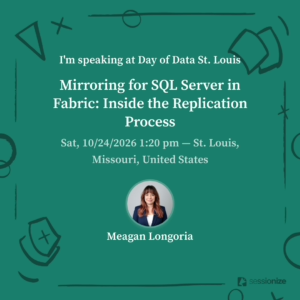
Meagan will take a technical look at the full replication process, tracing changes from the source database through how data lands and is retained in OneLake.
Mirroring for SQL Server in Microsoft Fabric promises near-real-time replication to OneLake—but what is actually happening under the hood?
Meagan will take a technical look at the full replication process, tracing changes from the source database through how data lands and is retained in OneLake.
The session will also cover:
- Configuring replicated objects.
- Monitoring replication health.
- Understanding the conditions that trigger a table replication restart.
For DBAs, data engineers, and architects evaluating or implementing SQL Server mirroring, this session offers an opportunity to move beyond the feature overview and understand the mechanics that matter when operating it.
The St. Louis event is free and in person, though attendance is limited by capacity. Organizers note that prior events have reached capacity, so prospective attendees should register early.
Practical Learning, Community Connections
At ProcureSQL, we value opportunities to share knowledge, learn from other practitioners, and help data professionals address the challenges they face every day.
These four sessions reflect that commitment: finding and understanding performance problems, protecting sensitive information, making thoughtful use of AI, and understanding the replication processes behind modern analytics platforms.
Day of Data builds on the SQL Saturday and PASS community tradition, bringing professionals together for technical learning and connections across the data community. St. Louis’s event includes tracks spanning SQL Server, Microsoft Fabric, Power BI, data engineering, AI, and professional development.
Whether you’re focused on maintaining your existing SQL Server environment or expanding into modern analytics, we hope you’ll join us and bring your questions.
Register and Join Us
- Day of Data Pittsburgh — October 10, 2026: View event details and the latest schedule. The event offers a full day of free training for Microsoft data-platform professionals.
- Day of Data St. Louis — October 24, 2026: View the schedule and register. The event is free, but organizers say purchasing a lunch ticket provides priority attendance and guarantees a spot; without one, entry is available only while space remains.
Join John in Pittsburgh or Meagan in St. Louis for practical learning, technical conversations, and a chance to connect with the ProcureSQL team.
Follow ProcureSQL for future event updates, practical SQL Server and data-platform guidance, and insights from our team as we help organizations build, manage, move, analyze, visualize, and govern their data.