• Link to Facebook
  • Link to Instagram
  • Link to LinkedIn
  • Link to Youtube
  • Link to X
Call Us Today! 512-640-5750
Data Architect as a Service | Remote DBA Services
  • Services
    • Analytics Architecture
    • Database Architecture
    • Software Architecture
    • Microsoft Fabric Consulting
      • Microsoft Fabric Health Check
  • About Us
    • Testimonials
    • Recommendation Program
    • Jobs
      • Data Engineering Consultant
      • Principal Data Analytics Architect
  • Blog
  • Contact
  • Click to open the search input field Click to open the search input field Search
  • Menu Menu

Tag Archive for: CDC

SQL Server 2025 Fabric Mirroring: Change Feed vs CDC Explained

Data Architecture, SQL Server

Mirroring of SQL Server databases in Microsoft Fabric was first released in public preview in March 2024. Mirrored databases promise near-real-time replication without the need to manage and orchestrate pipelines, copy jobs, or notebooks. John Sterrett blogged about them last year here. But since that initial release, the mechanism under the hood has evolved significantly. Let's talk about Fabric Mirroring: Change Feed vs CDC Explained.

How Fabric Mirroring Works in SQL Server 2016–2022 (CDC)

When mirroring was first released for Azure SQL Database, it used Change Data Capture (CDC). That is still what is used to mirror SQL Server 2016 – 2022.

CDC works by asynchronously scanning the transaction log to find changes related to tracked tables, then writing those changes to dedicated change tables — one per tracked source table, in the format cdc.schema_tablename_CT. A SQL Server Agent job (sys.sp_cdc_scan) is responsible for that log scan and write. Fabric’s replication layer then polls those change tables and pulls changes into OneLake, where they’re converted to Delta Parquet format. The result is a two-hop process: log → change table → OneLake. That intermediary write step is where the overhead lives. If you have a busy SQL Server, this overhead may not be acceptable.

Setting up CDC for SQL Server 2016–2022 requires the fabric_login principal to be a member of the sysadmin server role, at least temporarily, and any future CDC maintenance also requires sysadmin membership. For security-conscious organizations, that’s a significant ask. You can drop the login from sysadmin after CDC is configured, but having to elevate it in the first place causes friction.

 
In SQL Server 2016–2022, if a table’s schema changes after CDC is enabled, the mirrored table schema no longer matches the source, and mirroring fails. Getting replication back on track requires manually disabling and re-enabling CDC on the affected tables.

 
SQL Server 2025 Fabric Mirroring: The Change Feed Explained

SQL Server 2025 has a much better solution: the change feed. Rather than routing changes through change tables, the change feed scans the transaction log at a high frequency and publishes committed changes directly to a landing zone in OneLake. Fabric’s replicator engine then merges those files into the target Delta tables. The intermediary write step is gone.

Because the change feed doesn’t write data back into the source database, it carries lower overhead than CDC. There are no change tables to maintain, no SQL Server Agent jobs to keep healthy, and no cleanup jobs running in the background purging old change records. For busy OLTP systems where CDC’s performance overhead was a concern, this is a meaningful improvement.

DDL changes are handled better, too. Rather than failing when a schema change is detected, the change feed triggers a full re-snapshot of the affected table and reseeds the data automatically. That re-snapshot has a cost if the table is large, but it’s self-healing. You won’t come in Monday morning to find mirroring has been broken since Friday’s deployment.

The permissions model is also cleaner. Rather than requiring sysadmin elevation to configure CDC, SQL Server 2025 mirroring uses a system-assigned managed identity to handle outbound authentication to Fabric. You still create a dedicated login with minimal permissions on the source database, but sysadmin is never required.
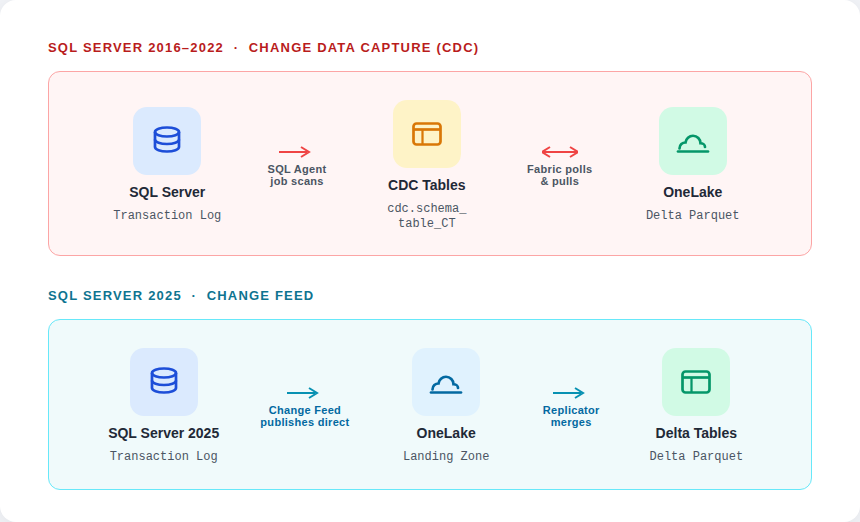
SQL Server 2025 Fabric Mirroring Change Feed vs CDC architecture diagram

How to Plan Your Fabric Mirroring Migration: CDC vs Change Feed

CDC-based mirroring is still what SQL Server 2016–2022 uses, and it works. Just go in with eyes open about the performance overhead, the sysadmin requirement, and the DDL limitations.

If you’re already on SQL Server 2025 or planning to upgrade, the change feed makes mirroring a more attractive option than it was under CDC — particularly for busy OLTP systems where the overhead of change table writes was a concern.

Before you enable mirroring on SQL Server 2025, there are a few constraints worth knowing. The source database must be set to the full recovery model (simple recovery is not supported). The change feed is also mutually exclusive with CDC: if CDC is already enabled on a database, you cannot enable Fabric mirroring on that same database. If you’re running CDC today for other consumers, you have a decision to make. You’ll need to decide whether to remove CDC and consolidate on the change feed or keep CDC and find another path for getting that data into Fabric.

Note: As of March 11, 2026, SQL Server 2025 mirroring is supported for on-premises instances only. It is not supported for SQL Server 2025 running in an Azure Virtual Machine or on Linux. It also requires the instance to be connected to Azure Arc with the Azure Extension for SQL Server installed.

Mirroring is still evolving, so it’s worth keeping an eye on the Fabric Mirroring roadmap. And of course, stay tuned for announcements from FABCON next week!

The post How Fabric Mirroring Transformed with SQL Server 2025 first appeared on Data Savvy.

March 11, 2026/by Meagan Longoria
https://procuresql.com/wp-content/uploads/2026/03/mirror-diagram.avif 522 860 Meagan Longoria /wp-content/uploads/2024/05/Data-Architecture-as-a-Service-with-ProcureSQL.png Meagan Longoria2026-03-11 22:48:232026-03-31 17:36:02SQL Server 2025 Fabric Mirroring: Change Feed vs CDC Explained
Join Our Newsletter
  Thank you for Signing Up
Please correct the marked field(s) below.
1,true,6,Contact Email,21,false,1,First Name,21,false,1,Last Name,2
Search Search

Blog Categories

  • $150 Challenge
  • Advice
  • Announcements
  • Artificial Intelligence
  • Awards
  • Azure Data Factory
  • C-Level
  • Cloud
  • Community
  • Conferences
  • Data Architecture
  • Data Integration
  • Data Intergration
  • Data Visualization
  • Data Warehousing
  • DBA 101
  • Design
  • Disaster Recovery or High Availability
  • Education
  • Fabric Dev Ops
  • Fabric Lakehouse
  • Fabric Lakehouses
  • Fabric Mirroring
  • Fabric Notebooks
  • Features
  • General
  • Health Checks
  • Lab
  • Microsoft Fabric
  • Microsoft Technologies
  • Newsletter
  • Performance Tuning
  • Power BI
  • ProcureSQL
  • Python
  • Reporting
  • Security
  • SQL Server
  • sql server 101
  • SQLServerPedia Syndication
  • syndication
  • The Blog
  • Uncategorized
  • Visual Studio Credit

Tags

#SQLFamily automatic tuning availability group azure backup Backups career Data Governance Data Loss Data Platform DBA Denver Differential Backup Disaster Recovery Fabric Fabric Architecture Full Backup High Availability Houston Marketing Database Administrator Microsoft Microsoft Fabric Microsoft SQL Server mirroring parameter sniffing PASS performance tuning Professional Development query store Recovery Recovery Model Restores Security SQL Saturday SQL Server SQL Server 2017 sql server 2019 SQL Server 2022 sql server 2025 SSMS System Databases Transaction Log Backup tsqltuesday Tuning Wait Stats

Archives

  • September 2026
  • August 2026
  • July 2026
  • June 2026
  • May 2026
  • April 2026
  • March 2026
  • February 2026
  • November 2025
  • October 2025
  • September 2025
  • July 2025
  • June 2025
  • May 2025
  • April 2025
  • March 2025
  • January 2025
  • December 2024
  • November 2024
  • October 2024
  • September 2024
  • August 2024
  • July 2024
  • June 2024
  • May 2024
  • February 2024
  • January 2024
  • November 2023
  • October 2023
  • March 2023
  • January 2023
  • May 2022
  • April 2022
  • November 2021
  • September 2020
  • August 2020
  • April 2020
  • March 2020
  • February 2020
  • January 2020
  • December 2019
  • November 2019
  • September 2019
  • July 2019
  • April 2019
  • November 2018
  • September 2018
  • August 2018
  • July 2018
  • June 2018
  • May 2018
  • April 2018
  • March 2018
  • February 2018
  • January 2018
  • November 2017
  • October 2017
  • August 2017
  • July 2017
  • June 2017
  • April 2017
  • December 2016
  • November 2016
  • October 2016
  • July 2016
© Copyright 2026 - ProcureSQL - 1464 East Whitestone Blvd., Suite 1902 Cedar Park, TX 78613, USA
  • Link to Facebook
  • Link to Instagram
  • Link to LinkedIn
  • Link to Youtube
  • Link to X
Scroll to top Scroll to top Scroll to top
Manage Consent
To provide the best experiences, we use technologies like cookies to store and/or access device information. Consenting to these technologies will allow us to process data such as browsing behavior or unique IDs on this site. Not consenting or withdrawing consent, may adversely affect certain features and functions.
Functional Always active
The technical storage or access is strictly necessary for the legitimate purpose of enabling the use of a specific service explicitly requested by the subscriber or user, or for the sole purpose of carrying out the transmission of a communication over an electronic communications network.
Preferences
The technical storage or access is necessary for the legitimate purpose of storing preferences that are not requested by the subscriber or user.
Statistics
The technical storage or access that is used exclusively for statistical purposes. The technical storage or access that is used exclusively for anonymous statistical purposes. Without a subpoena, voluntary compliance on the part of your Internet Service Provider, or additional records from a third party, information stored or retrieved for this purpose alone cannot usually be used to identify you.
Marketing
The technical storage or access is required to create user profiles to send advertising, or to track the user on a website or across several websites for similar marketing purposes.
  • Manage options
  • Manage services
  • Manage {vendor_count} vendors
  • Read more about these purposes
View preferences
  • {title}
  • {title}
  • {title}