Corruption. We know it is everywhere. It is surely a hot-button issue in the news. If you have not given much thought to database integrity, now is the time to sit up and pay attention. Corruption can occur at any time. Most of the time database corruption is caused by a hardware issue. No matter the reason, being proactive on database integrity will ensure your spot as a hero DBA in the face of corruption.
A single lie destroys a whole reputation of integrity – Baltasar Gracian
Integrity is one of those words people throw around quite often these days. The definition of integrity is the quality of being honest and having strong moral principles. How can data have strong moral principles? Does data integrity mean something different? Yes, data integrity refers to the accuracy and consistency of stored data.
Have Backups, Will Travel
When was the last time an integrity check was run on your database? If you are sitting there scratching your brain trying to find the answer to that question, you may have serious issues with your database and not know it.
But, I have solid backup plans in place, so this means I am okay. Right?
While having a solid backup and recovery plan in place is an absolute must, you may just have solid backups of corrupt data. Regular integrity checks will test the allocation and structural integrity of the objects in the database. This can test a single database, multiple databases (does not determine the consistency of one database to another), and even database indexes. Integrity checks are very important to the health of your database and can be automated. It is suggested to run the integrity check as often as your full backups are run.
As discussed in an earlier blog, Validating SQL Server Backups, your data validation needs to take place BEFORE the backups are taken. A best practice is to run a DBCC CHECKDB on your data to check for potential corruption. Running CHECKDB regularly against your production databases will detect corruption quickly. Thus providing a better chance to recover valid data from a backup, or being able to repair the corruption. CHECKDB will check the logical and physical integrity of the database by running these three primary checks*:
- CHECKALLOC – checks the consistency of the database;
- CHECKTABLE – checks the pages and structures of the table or indexed view; and
- CHECKCATALOG – checks catalog consistency.
Where to Look
Wondering if you have missing integrity checks or if they have ever been performed on your database? The following T-SQL script will show when/if integrity checks were performed on your databases. (Bonus) Running this script regularly will help track down missing integrity checks.
If you are looking for the last date the DBCC checks ran, the T-SQL script to use is as follows:
IF OBJECT_ID('tempdb..#DBCCs') IS NOT NULL

DROP TABLE #DBCCs;

CREATE TABLE #DBCCs

(

ID INT IDENTITY(1, 1)

PRIMARY KEY ,

ParentObject VARCHAR(255) ,

Object VARCHAR(255) ,

Field VARCHAR(255) ,

Value VARCHAR(255) ,

DbName NVARCHAR(128) NULL

)
/*Check for the last good DBCC CHECKDB date */

BEGIN

EXEC sp_MSforeachdb N'USE [?];

INSERT #DBCCs

(ParentObject,

Object,

Field,

Value)

EXEC (''DBCC DBInfo() With TableResults, NO_INFOMSGS'');

UPDATE #DBCCs SET DbName = N''?'' WHERE DbName IS NULL;';
WITH DB2

AS ( SELECT DISTINCT

Field ,

Value ,

DbName

FROM #DBCCs

WHERE Field = 'dbi_dbccLastKnownGood'

)

SELECT @@servername AS Instance ,

DB2.DbName AS DatabaseName ,

CONVERT(DATETIME, DB2.Value, 121) AS DateOfIntegrityCheck

FROM DB2

WHERE DB2.DbName NOT IN ( 'tempdb' )

END
The result will look similar to this. However, let’s hope your results show a date closer to today’s date than my own! If you see that your databases do not have integrity checks in place, check your backup and recovery plans and double check your agent jobs to see if perhaps the checks were scheduled but were turned off.

Recommendations
It is recommended that DBCC CHECKDB is run against all production databases on a regular schedule. The best practice is to have this automated and scheduled as a SQL Agent job to run as a regular part of maintenance. More specifically, to run the integrity check directly before purging any full backups. Doing so will ensure that corruption is detected quickly, which will give you a much better chance to recover from your backup or being able to repair the corruption.
Remember, SQL Server is very forgiving and will back up a corrupt database! Corrupt databases are recoverable, but they might have data pages that are totally worthless!
What is the best way to learn?
   The best way to learn is directly from industry professionals! We are thrilled to be helping the SQLSaturday Wheeling organizers put together a great SQLSaturday, April 28, 2018. The schedule is packed full of knowledgeable SQL professionals waiting to share their unique experiences and knowledge with you!
What is SQLSaturday?
   SQLSaturday is a free training event for Microsoft Data Platform professionals and those wanting to learn about SQL Server, Business Intelligence and Analytics. Admittance to this event is free, and most costs are covered by donations and sponsorships. This event will be held on Apr 28 2018 at West Virginia Northern Community College, 1704 Market Street, Wheeling, West Virginia, 26003, United States. You can register here: SQLSatWheeling
* To register for a SQLSaturday, you must first become a PASS member. A PASS account is free and makes it convenient to manage your SQLSaturday user profile, update preferences, and keep track of your SQLSaturday registrations.
What topics will be discussed?
   SQLSaturdays offer a wide variety of sessions from beginner to advanced. There truly is something for every data professional at every level of his or her career.
- Â The topics covered are:
- Analytics and Visualization
- Application and Database Development
- BI Information (Delivery, Architecture, Development, and Administration)
- Cloud Development and Implementation
- Enterprise Database Administration and Deployment
- Professional Development
   The full schedule for SQLSaturday Wheeling can be found here.
What else does a SQLSaturday offer?
   Education is a very important element in growing your career. Another often over-looked important element to growing a successful career is networking! SQLSaturdays provide an excellent opportunity to meet new people, reconnect with old, and have a great time networking. There will be a networking event Saturday after the event, so you will have a chance to unwind, grab a bite to eat, and chat with your newfound SQL friends!
   We will be there, and we hope to see you as well! 
Procure SQL is a proud sponsor of PASS SQL Saturday Houston, June 17, 2017! This is a free event for you, your employees, teammates or anyone interested in learning SQL Server for free. Make sure you sign up and come on down.Â
Please stop by the booth and say hello to me. Â I would love to meet you! Â Mention that you read this blog and I will have a gift for you! Â
I will have a prize wheel to spin for cool prizes, one of which is a hand spinner! Â They are all the rage. Â Have you ever played with one? Â They are great for calming me during heavy database work!
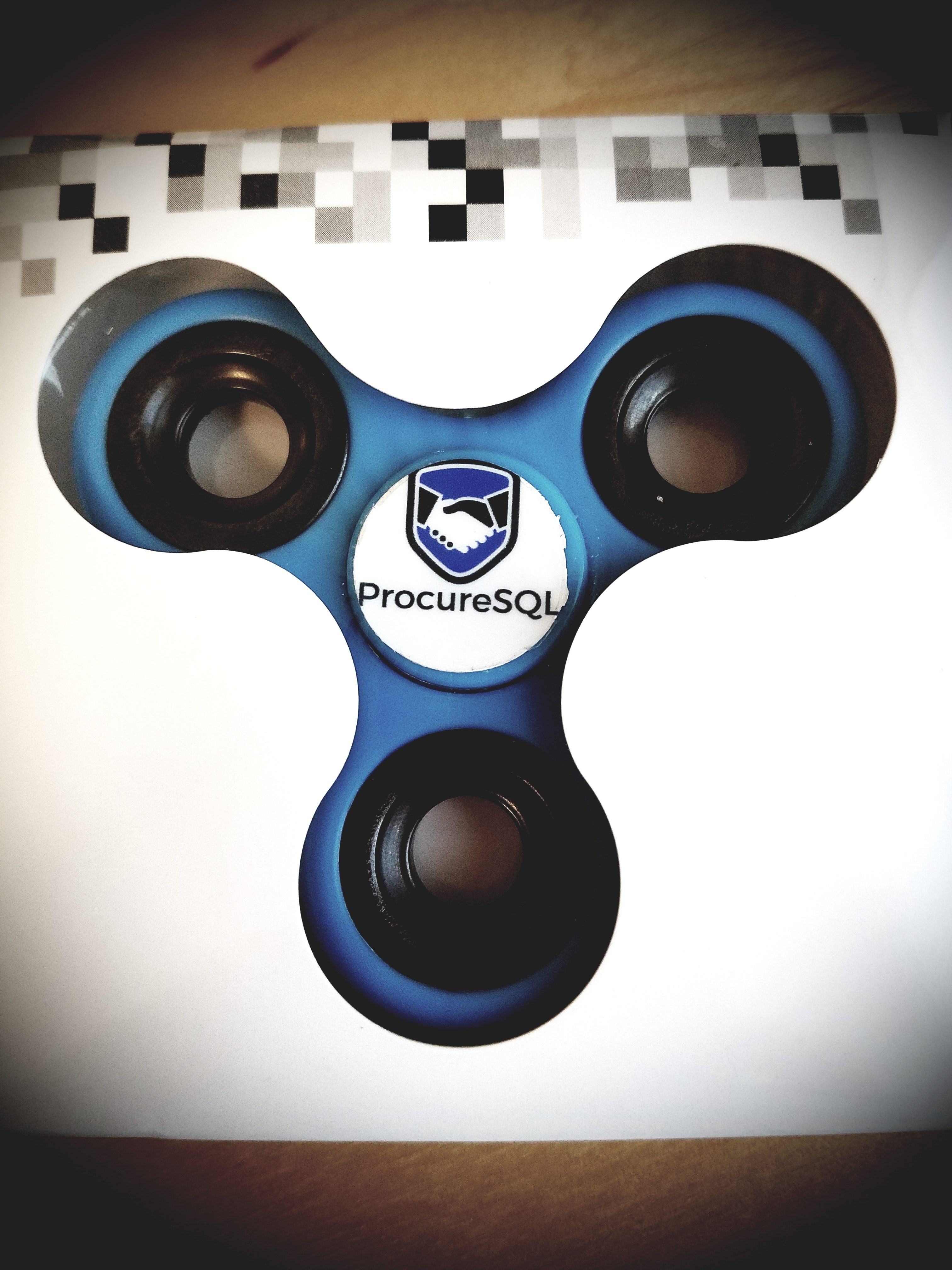
We have the spinners…
Our founder, John Sterrett, will be speaking at 4pm. Â Be sure to drop in and say hello before or after the session!
His session is titled Table Partitioning: the Secret Weapon for Your Big Data Problems.
"Is big data starting to slow you down? Is data growth putting your maintenance tasks in danger of not meeting your service level agreements?
Do you wish you could archive old data with minimal impact to your tables during the archive process?
Do you wish you could eliminate the majority of the data in your tables when you query them? If so, it's time you consider implementing
table partitioning to help with your general performance and to reduce your maintenance window for completing your maintenance tasks.

In this session, you will learn how table partitioning works and when it should be implemented. You will be able to understand how to
initially configure partition functions and partition schemes to have a rock solid partitioned table. You learn how to implement new features
added in SQL Server 2014 to improve table partitioning.  Finally, you will learn how to implement an automated sliding window to maintain
your partitioned tables for ensuring optimal performance."